
From 1 January 2021 the guidelines on the application of the definition of default (EBA/GL/2016/07) are in effect in all EU countries. Their purpose is to ensure a common and consistent definition of default across institutions, not only under the same local supervisor but also across EU countries. One key component is the introduction of a new standard on the materiality rule for the past due criterion in the counting of days past due and the identification of default.
Our experience of credit portfolios in many countries confirms that there is a diversity of implemented versions of the past due criteria, which makes the EBA's aim of establishing common ground reasonable. However, the requirements bring new dynamics and additional challenges for financial institutions. In this article we discuss the patterns introduced under the new definition, the potential impact on a bank's portfolios and models, and the applicability of the definition in making business decisions.
The mechanics
The new standard on counting delinquency
Among other changes, under the new definition the counting of days past due begins from the moment when the sum of the past due amounts breaches the relative and absolute thresholds. This approach has two main characteristics:
- There is a delay in the identification of delinquencies and defaults, as the counter begins only when the total past due amount becomes material.
- The counter continues to increase even where some repayment of past due amounts is made, as long as both thresholds remain breached.
The worked example below follows a retail non-forborne mortgage loan through fifteen months, comparing the past due criterion under the new definition with the past due counter as it was calculated before the change.
| Observation date | Requested | Paid | Delinquent | Remaining balance | Missed payment | Absolute materiality fail | Relative materiality fail | DPD before | DPD after | Status before | Status after |
|---|---|---|---|---|---|---|---|---|---|---|---|
| 31/01/2021 | €500 | €500 | — | €49,500 | No | No | No | 0 | 0 | Performing | Performing |
| 28/02/2021 | €500 | €500 | — | €49,000 | No | No | No | 0 | 0 | Performing | Performing |
| 31/03/2021 | €500 | €500 | — | €48,500 | No | No | No | 0 | 0 | Performing | Performing |
| 30/04/2021 | €500 | €250 | €250 | €48,250 | Yes | Yes | No | 30 | 0 | Performing | Performing |
| 31/05/2021 | €500 | €500 | €250 | €47,750 | Yes | Yes | No | 30 | 0 | Performing | Performing |
| 30/06/2021 | €500 | €500 | €250 | €47,250 | Yes | Yes | No | 30 | 0 | Performing | Performing |
| 31/07/2021 | €500 | — | €750 | €47,250 | Yes | Yes | Yes | 60 | 30 | Performing | Performing |
| 31/08/2021 | €500 | €500 | €750 | €46,750 | Yes | Yes | Yes | 60 | 60 | Performing | Performing |
| 30/09/2021 | €500 | €500 | €750 | €46,250 | Yes | Yes | Yes | 60 | 90 | Performing | Non-performing |
| 31/10/2021 | €500 | €500 | €750 | €45,750 | Yes | Yes | Yes | 60 | 120 | Performing | Non-performing |
| 30/11/2021 | €500 | €500 | €750 | €45,250 | Yes | Yes | Yes | 60 | 150 | Performing | Non-performing |
| 31/12/2021 | €500 | €1,250 | — | €44,000 | No | No | No | 0 | 0 | Performing | Non-performing |
| 31/01/2022 | €500 | €500 | — | €43,500 | No | No | No | 0 | 0 | Performing | Non-performing |
| 28/02/2022 | €500 | €500 | — | €43,000 | No | No | No | 0 | 0 | Performing | Non-performing |
| 31/03/2022 | €500 | €500 | — | €42,500 | No | No | No | 0 | 0 | Performing | Performing |
Both materiality thresholds are breached in July 2021 and the material past due counter begins to run, but further time is needed before the default event is triggered. Despite regular payments of past due amounts, the exposure continues to be delinquent, because the remaining past due amounts still breach the materiality thresholds. Full repayment arrives in December 2021, yet the exposure remains non-performing until March 2022 — a further three months — because of the probation period introduced with the new default exit criteria.
By contrast, the existing past due counter shows delinquent behaviour from the first unpaid amount, yet never reaches non-performing status (90+ DPD) — irrespective of the materiality threshold used in the default definition — because of the regular repayments of past due amounts.
Portfolio impact
Distribution and flow
The introduction of the new definition of default in retail portfolios may affect, to varying degrees, all aspects of credit risk modelling and reporting. The effect in terms of non-technical defaults can be complicated, and depends on the definition each institution already had in use before complying with the new standard.
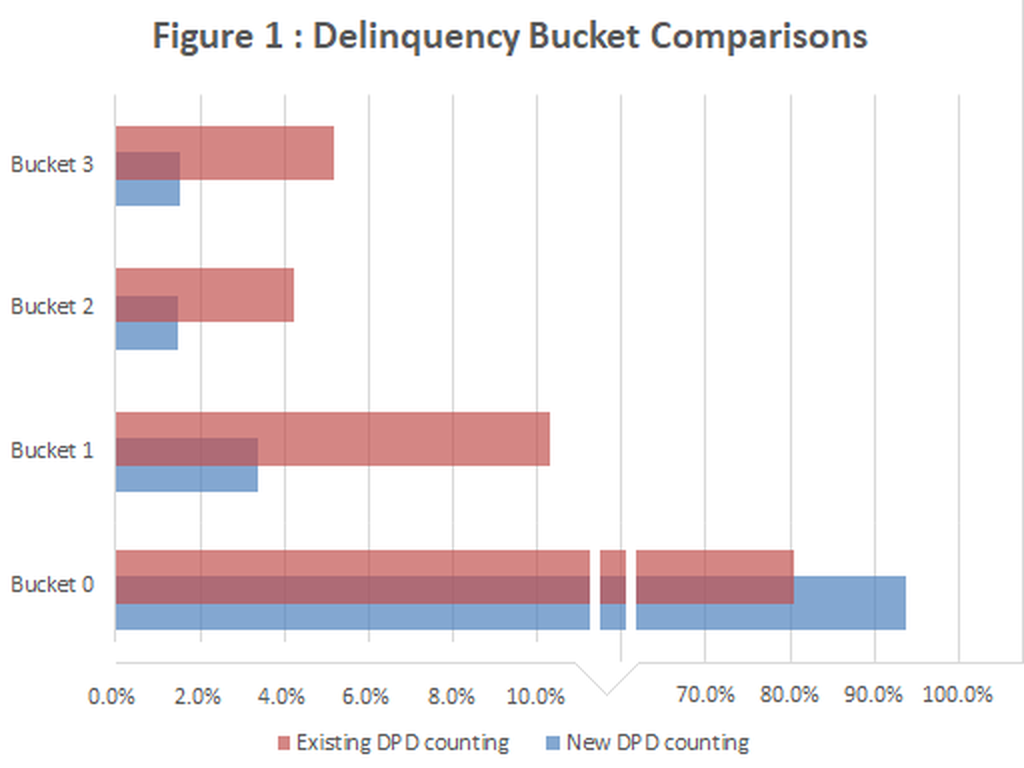
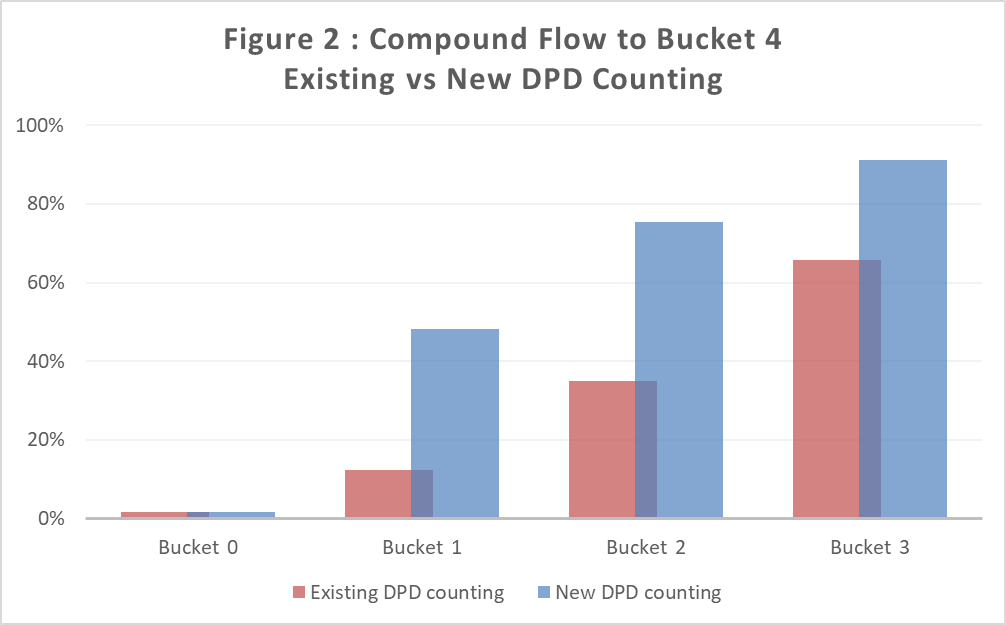
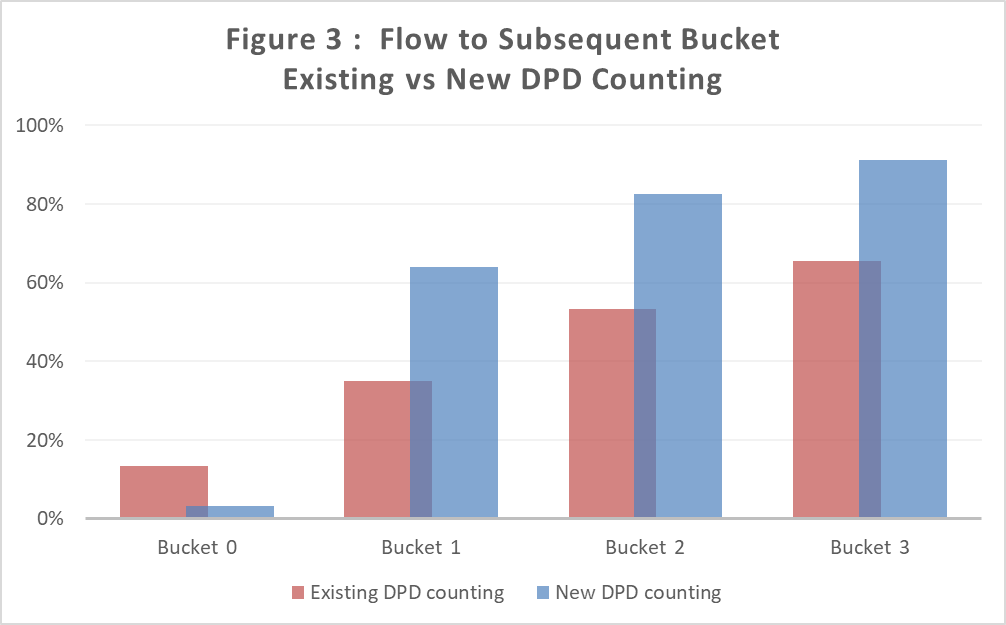
The three charts below are drawn from a retail mortgage portfolio: the distribution of exposures at each DPD group or bucket under the new DPD calculation against the existing one (Figure 1); the compound flow rate to bucket 4 from a given current delinquent state (Figure 2); and the flow rate to subsequent buckets (Figure 3).
The main points to consider are:
- The materiality thresholds in days past due counting create a higher concentration of exposures in the 0 DPD group ("bucket 0") relative to the existing DPD counting, where delinquent amounts fail to exceed both thresholds.
- For the new material DPD, where the past due amount remains above the thresholds, delinquency buckets 1–3 are only transitory stages: an exposure either continues into higher delinquency buckets, eventually reaching non-performing status, or returns to current status if adequate repayments are made. This transitory behaviour is evident in Figures 2 and 3, where on average there is a higher flow rate to subsequent buckets — and ultimately to bucket 4 — under the new DPD counting than under the existing one.
- The lower proportion of the bucket 0 population and its higher flow to bucket 1 illustrate the early warning nature of the existing DPD counting, which can identify payment difficulties even before they become material.
Risk profile
The contamination of bucket 0
Default rates under the new definition, for the population sitting in “bucket 0” under the new DPD counting, segmented by where the same exposures fall under the existing DPD counting — a retail mortgage portfolio:
| Existing bucket | Share of new “bucket 0” | 12-month bad rate |
|---|---|---|
| 0 | 93.8% | 0.8% |
| 1 | 5.4% | 5.9% |
| 2 | 0.7% | 11.2% |
| 3+ | 0.1% | 21.4% |
| Total new “bucket 0” | 100.0% | 1.1% |
The table shows a contamination effect, especially under the new definition. The higher concentration of exposures in bucket 0 conceals segments of the portfolio with a riskier profile. The existing past due counter is able to identify those riskier segments, mainly because it can flag exposures with missed payments before the total past due amount becomes material under the new definition.
Combining the new materiality DPD counter with a more traditional DPD counter could therefore identify portfolio segments with different risk profiles, creating more robust rating systems.
Business impact
Where the regulatory definition does not serve the business
By design, the new definition of default reflects supervisors' objectives and point of view, leaning towards a more conservative approach to the classification of NPE exposures. That may not be optimal for business decisions, where close monitoring of exposure performance is required for prudent risk management. Potential hurdles in using the new definition of default to manage portfolios include:
- Customers who make regular payments but do not repay their total past due amount — effectively remaining above the materiality thresholds — will eventually be classified as NPE under the new definition. This may happen in deviation from their contractual terms, with implications for the bank–customer relationship, especially if the information reported to credit bureaus results in a sudden worsening of their credit rating. In business terms such profiles are profitable for the bank, providing additional interest earnings, while carrying a moderate risk profile.
- The new definition lags in identifying delinquent exposures until they become materially past due. It is therefore less applicable for collections purposes, where early delinquency tracking and management is important for prudent collections strategies.
- Exposures in probation, even if classified as non-performing until probation completes under the new definition of default, exhibit actual repayment behaviour and should be monitored closely, or even managed as performing. The prolonged NPE classification puts them in the middle: they are probably not suitable for management by collections if they are following a payment schedule, and they are excluded from most models applied to performing exposures.
Conclusion
Decode the new dynamics before relying on them
The new definition of default is a regulatory definition which introduces new dynamics into loan portfolios. Financial institutions should consider additional information and not rely solely on the new definition of default when they assess their business policies and set their strategies.
The challenge is therefore to decode the new portfolio dynamics and their impact, model that behaviour, and assess whether the new definition of default is aligned with business practice. Rebuilding default flags on historical data usually means recalibrating rating and behaviour models and the IFRS 9 risk components estimated from them. All of these changes need to be assessed during a period of high uncertainty introduced by the ongoing COVID-19 pandemic, which could limit the ability of financial institutions to run the assessment on representative sample periods.
Talk to us about recalibrating under the new definition
We help institutions quantify the distribution and flow impact of the definition of default, rebuild default flags on historical data and recalibrate rating and IFRS 9 models accordingly.
Get in touch